

Himalaya Enclave Vrindavan Yojna Lucknow: RERA Phases
What is Himalaya Enclave in Vrindavan Yojna, Lucknow?
In short: Himalaya Enclave in Vrindavan Yojna, Lucknow is a Parishad flat project with two UP RERA records: UPRERAPRJ7922 and UPRERAPRJ8977. Both say Completed, with 2018 completion dates.
If you have already found a flat here and want the title, encumbrance and court records checked before you pay a token, our property verification page lists exactly which offices we search. Only the first check is free; the full report is paid.
Now the longer answer. Search the name and you get portals that call it "UPAEVP Himalaya Enclave", "Vrindavan Colony" or "Phase-2 (Sector-17)", and a RERA page with "Phase I & III" in the title. It reads like three projects. It is not three. We went to the registration records and read those instead, because a listing can say anything and a record has to say one thing.
At a glance, as of 13 November 2026: two registrations, one promoter, U.P. Awas Evam Vikas Parishad. Phase I & III has 816 flats on the record, Phase-2 has 208. Both completion dates passed in 2018. We won't give a price figure. Check every registration detail in this guide against the live RERA portal before you rely on any of it.
Who built Himalaya Enclave, and who sells it now?
The promoter on both records is U.P. Awas Evam Vikas Parishad. The Parishad's own site, upavp.in, is titled "Official Website of Uttar Pradesh Housing & Development Board, India". Same body, two names, so we say "the Parishad" from here on.
That makes this a state housing body's project, not a private builder's and not an LDA scheme. If that split is new to you, our guide to what Vrindavan Yojna is and who runs it explains why it matters.
The contractors differ by phase. Phase I & III names L&T Limited, as both contractor and structural engineer. Phase-2 names Marg Limited in both roles. The architect is Arinem Consultancy on both, written slightly differently on each page. That alone is not alarming. But it is a good reason never to assume that "Himalaya Enclave" is one set of papers.
One honest gap. When we opened the Parishad's home page on 13 November 2026, neither Himalaya Enclave nor Vrindavan Yojana appeared on it. The site announces schemes as dated PDF notices under What's New and Public Notices. So we cannot point you to an official page about this project on its own site.
Most flats sold here today are resales, we assume, since the project was finished years ago. The seller, not the Parishad, will be the one you pay. That is why the papers matter more than the name.
What do the two UP RERA records say?
Aurum Proptech carries copies of both. It says its data is "collated from publicly available resources" and does not guarantee accuracy. So use them to know what to ask, not as proof.
Himalaya Enclave, the two registrations side by side, as the copies read on 13 November 2026
| Item | Phase I & III | Phase-2 (Sector-17) |
|---|---|---|
| RERA number | UPRERAPRJ7922 | UPRERAPRJ8977 |
| Promoter | U.P. Awas Evam Vikas Parishad | U.P. Awas Evam Vikas Parishad |
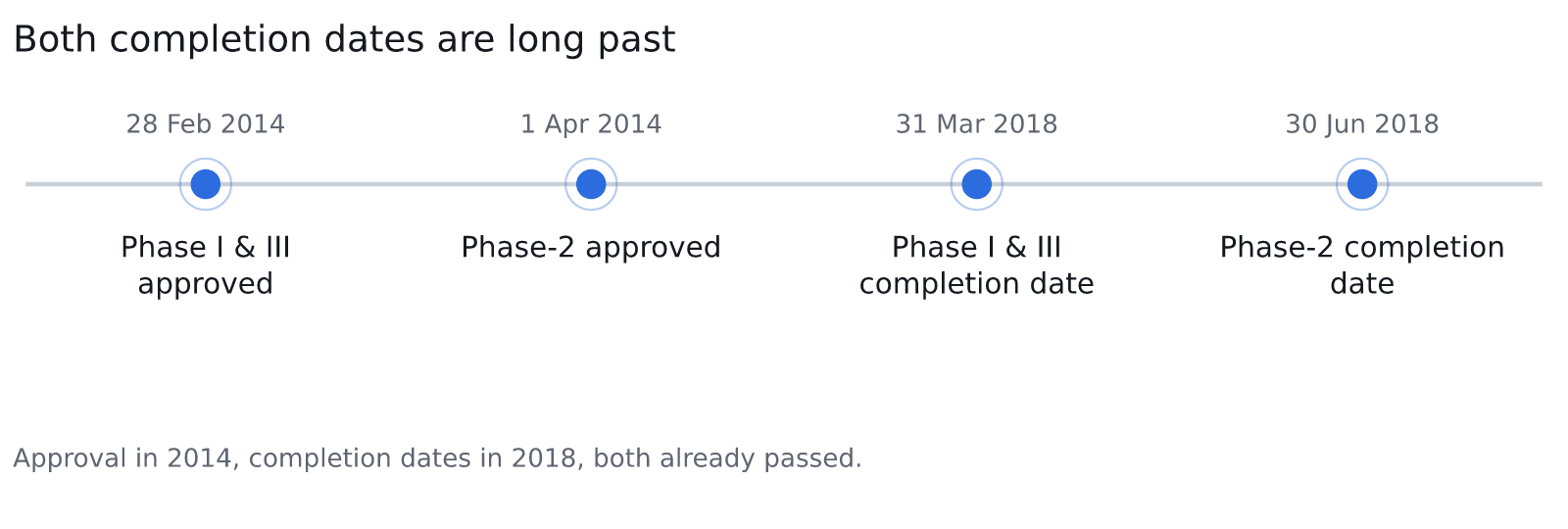
| Approval date | 28 February 2014 | 1 April 2014 |
| Completion date | 31 March 2018 (50 months) | 30 June 2018 (51 months) |
| Status | Completed | Completed |
| Total area | 40,529 sqm | 10327 sqm |
| Project cost on record | 43,174.19 lacs | 11122.71 Lacs |
| Contractor | L&T Limited | Marg Limited |
Source: Aurum Proptech, UPRERAPRJ7922 and Aurum Proptech, UPRERAPRJ8977
The cost row is the record's own wording, in lacs, and we have left it that way. It is a project cost, not the price of a flat. Do not divide it by anything.
The row that matters is the completion date. 31 March 2018 and 30 June 2018 have both passed, by years. For a finished project that is less alarming than for a tower still going up. Still, say it to yourself in those words, and ask the seller whether any extension was ever filed. A RERA date is a promise on paper, and we never tell you a project met one.
Phase I & III: which block is which flat?
This is the larger record, and the one that decides what you are actually looking at. Ten blocks, mostly 13 floors, listed with a type and a carpet area each. The record says Phase I & III covers a group housing plot in "sector-17/18 Vrindavan Yojna". So Sector-18 holds more than one Parishad project. Our Kailash Enclave page, for example, is at Sector-18 too, under a different number.
Phase I & III by block, per the RERA copy
| Blocks | Type | Carpet area | Units |
|---|---|---|---|
| A1 and part of B6 | 1 BHK | 46.34 sqm (about 500 sq ft) | 120 |
| B1, B2, B6 | 2 BHK | 70.68 sqm (about 760 sq ft) | 296 |
| B3, B4 | 2 BHK | 87.12 sqm (about 940 sq ft) | 204 |
| C1, C2 | 3 BHK | 106.75 sqm (about 1,150 sq ft) | 96 |
| D1, D2 | 3 BHK | 115.25 sqm (about 1,240 sq ft) | 88 |
| C1, D1, D2 (top floor) | Penthouse | 175.62 and 183.77 sqm | 12 |
Source: Aurum Proptech, UPRERAPRJ7922. Square feet are our rounded conversion (sqm times 10.764).
Two points before you read anything into it.
First, there are two kinds of 2 BHK. B1, B2 and the lower floors of B6 are 70.68 sqm. B3 and B4 are 87.12 sqm. Same label, a very different flat. If a listing says "2 BHK in Himalaya Enclave" and gives no block, you do not yet know which one you are being offered. Ask for the block and floor, then match the carpet area to the record.
Second, B6 is a mix. Its floors 1 to 11 are 2 BHK and floors 12 and 13 are 1 BHK. In C1, D1 and D2 the penthouse sits on floor 12. So the floor number can change the type, even in the same tower.
The record lists 816 units in total. The unit counts are worked out from its floor-by-floor rows, so we would rather you read those rows than trust a headline figure, ours included.
Phase-2 (Sector-17): a smaller record, a different address
Phase-2 is three blocks, each 13 floors. The record gives units per floor, so the totals are our arithmetic: 208 in all.
Phase-2 (Sector-17) by block, per the RERA copy
| Block | Type | Carpet area | Units per floor | Our total |
|---|---|---|---|---|
| B5 | 2 BHK | 70.68 sqm (about 760 sq ft) | 8 | 104 |
| C3 | 3 BHK | 106.75 sqm (about 1,150 sq ft) | 4 | 52 |
| D3 | 3 BHK | 115.25 sqm (about 1,240 sq ft) | 4 | 52 |
Source: Aurum Proptech, UPRERAPRJ8977. Totals are our multiplication, units per floor times 13.
Notice the carpet areas. B5 is 70.68 sqm, the same as the smaller 2 BHK in Phase I & III. C3 and D3 repeat the two 3 BHK sizes. The designs are shared; the registrations are not. So a seller in B5 and a seller in B2 may describe the same-sized flat, but they sit under two different RERA numbers. Ask which one the flat is under.
Put the two records together and you get 1,024 flats on paper. One promoter, two contractors, a lot of homes. That is why resale listings under the name are easy to find and hard to compare.

Where the records do not add up
Three things stood out. None is proof of a problem. All three are questions.
The land. Phase-2 lists four land parcels, which add up to 13,540 sqm, yet the total project area is 10327 sqm. Phase I & III has the same kind of gap: its land entries add up to more than its 40,529 sqm. The pages do not explain either. Land held for a project is not always the land built on, and a copy can be incomplete. Still, a seller who says "the plot is exactly this size" is guessing. Ask what the title papers say.
The works. Both records list the development works, from boundary wall and bituminous road to water supply, sewage treatment and rain water harvesting. But neither gives a completion status for any item. Compare that with our Kailash Enclave page, where the record did give statuses, and they conflicted with "Completed". Here we have no statuses at all. So the record cannot tell you whether the compound is finished, only what was planned for it. Walk it.
The accounts. Phase I & III lists a project bank account held by "Executive Engineer CD-19, RERA Himalaya Enclave Phase 1 & 3". Phase-2 lists its own, in the same style. So each registration has its own account. We have left the numbers out. The point is simpler: if anyone asks you for money against one of these flats, ask for the account holder's name in writing and match it to the papers.
What do listings say, and what can you not tell from them?
Price first. We did see portals quote prices for Himalaya Enclave flats. We did not use them. They carry no date, the pages sell property, and we could not tell whether a figure was for Phase-2 or Phase I & III, for a 1 BHK or a penthouse. A price with no "as of" date is one we would not repeat.
Sizes next. Portals quote ranges in square feet, and the two we saw did not match each other. We have not repeated them. The record gives you carpet areas in square metres, block by block, and that is the number to hold a seller to. Our posts on built-up area vs carpet area and super built-up area vs carpet area show how a quote on a bigger area makes the same flat look cheaper per foot than it is. Here is the sum with made-up numbers. Say a seller quotes on 250 sq ft and your carpet area is 200 sq ft. You are being charged on 50 sq ft you cannot stand on. These figures are an illustration, not Himalaya Enclave's. For the scheme-wide picture, why Vrindavan property rates disagree is the page to read.
Location last. The same project appears as "Vrindavan Colony", "Vrindavan Yojana" and "Sector-17". These are mostly the same part of Lucknow with different labels, and our pin code guide explains why the codes on addresses here do not always agree. For a sale, the address on the papers wins.
How do you check the number on the UP RERA portal?
The portal is up-rera.in. Its search group lists Registered Promoter, Registered Agent, Registered Projects, Completed Projects, De-registered Projects, NCLT Projects, Abeyance Projects and Withdrawn Registration. Under services there is a Verify RERA Registration link. Complaints have their own menu, with Register Complaint and Complaint Status, and there is a request for a certified copy of a document.
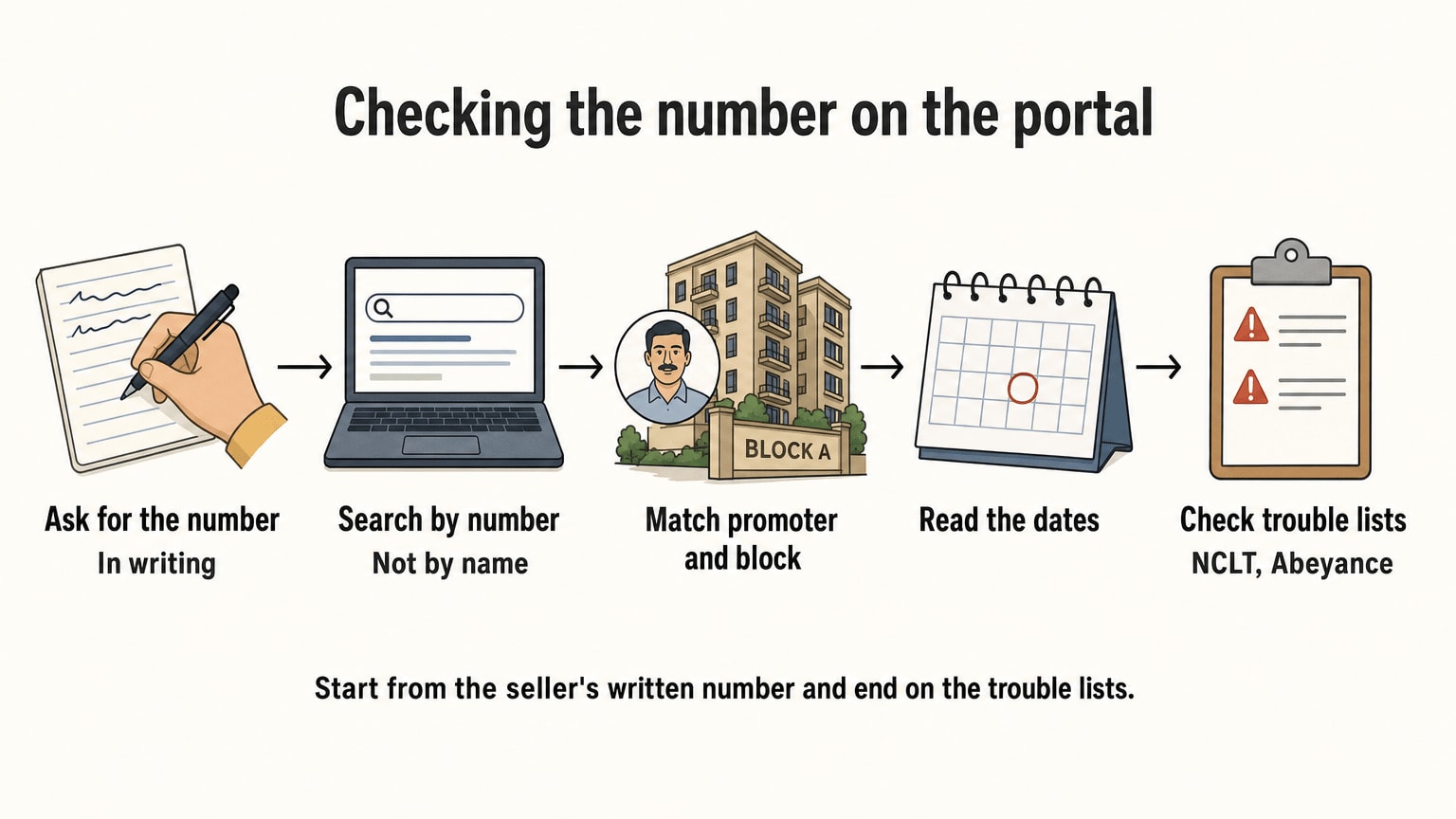
- Ask the seller for the RERA number in writing. We read UPRERAPRJ7922 and UPRERAPRJ8977. If you are shown something else, ask why.
- Search by the number, not the name. Look under Completed Projects, since both are marked Completed. Also look at Registered Projects.
- Match the promoter to U.P. Awas Evam Vikas Parishad and the block to the one on your papers.
- Read the dates. Do they match what we read here? If they have changed, an extension may have been filed.
- Check the lists you would not want to find it on: De-registered, NCLT, Abeyance and Withdrawn.
- If a dealer is involved, ask for the dealer's agent number and search it under Registered Agent. Our post on verifying a dealer's number shows how.
We could not run the portal's search ourselves, because it needs a form. Whatever you see there beats our copy.
What does "Completed" actually tell you?
Less than it sounds. Both pages say the project "has been fully built and is ready for possession or use". That line is the portal's wording for the Completed status. It says the promoter marked the project finished. It does not say the flat in front of you has an occupancy paper, a clear title or a working lift.
Think of it as the start of your questions. A completed project means you can see the thing, which is a real advantage over a tower that exists as a drawing. You can stand in the lobby. You can count the cars. You can ask the person on the fifth floor how the water pressure is in June. That is worth more than any brochure.
It also means the usual RERA worry, whether the builder will hand over on the date, is behind you. What replaces it is the resale worry: is this seller the person on the allotment letter, and does anyone else have a claim on the flat? The first question is answered by the portal. The second is answered by the papers, and only the papers.
What does stamp duty add on a resale?
On a resale the seller sets the price, and the state adds its own charge on top. The rates we use are 7% for men and 6% for women up to ₹1 crore, plus 1% registration. Our stamp duty calculator works from the circle rate, so ask the registration office which value your deed will be charged on.
Here is the sum with made-up numbers. Say the deed value is 100. Duty at 7% is 7, and registration at 1% is 1. Both are paid on top of the 100. These are illustrations, not a quote for any flat here. If the deed is valued on a number twice as big, the duty doubles with it. The Lucknow stamp duty calculator does this properly, and its result is an estimate. For a deed above ₹1 crore, check which rate applies before you rely on 7%.
What should you check before a token?
In this order.
- Block, floor and flat number, and the type. Match the carpet area to the tables above.
- Which RERA number the block sits under, and the status you see on the portal.
- Allotment letter, earlier sale deeds and any loan on the flat. Ask who holds the title today.
- The mutation entry and the Parishad's records of the transfer. We won't give a figure for the Parishad's resale transfer fees. Ask its office what it needs from a buyer.
- Maintenance dues, who collects them, and the last receipt.
- The total price in writing, with an "as of" date, and what stamp duty adds, as above.
- A home loan sanction letter. A bank's number counts. A calculator's does not.
Then go and look. A weekday morning and a weekend evening show you water, lifts, parking and the state of the common areas. These are 13-floor towers, so ask about lift waits at the top. Ask a resident, not the seller. A fair seller of a clean flat can wait a few days for a title check. If the answer is "pay a token today", we would take that as the answer.
Will the new projects nearby change what you pay?
A bus terminal, a convention centre and an AI City are planned in the scheme, and our Vrindavan Yojna guide tracks them. None is finished. Our rule of thumb: only what is built, approved and funded should move what you pay today, and even then it is a reason to ask, not a reason to pay more. Nobody can promise appreciation or rent, and a seller who says "prices only going up" is selling.
Our view: the Parishad's name tells you who held the land and built the flats. It does not tell you the flat in front of you has a clean title or a finished compound. The papers do. If you are comparing this with other flats in the scheme, flats in Vrindavan Yojna lists what to shortlist and why. We have read other projects in the scheme from their records too: Ratan Galaxy, Eldeco Saubhagyam and Azea Botanica.
Frequently asked questions
Who built Himalaya Enclave in Vrindavan Yojna?
Both RERA copies we read name U.P. Awas Evam Vikas Parishad as promoter. L&T Limited is the contractor on Phase I & III, and Marg Limited on Phase-2. Check the promoter name on the UP RERA portal yourself.
What is the RERA number of Himalaya Enclave?
There are two. Phase I & III is UPRERAPRJ7922 and Phase-2 (Sector-17) is UPRERAPRJ8977, per copies we read on 13 November 2026. Search the number on up-rera.in and ask which one your block is under.
Is Himalaya Enclave ready to move?
Both records are marked Completed, with completion dates of 31 March 2018 and 30 June 2018. Neither record gives a status for each work, so walk the compound and ask for the completion paperwork.
How big is a flat in Himalaya Enclave?
By carpet area: 46.34 sqm for 1 BHK, 70.68 or 87.12 sqm for 2 BHK, 106.75 or 115.25 sqm for 3 BHK, and penthouses of 175.62 or 183.77 sqm. That is about 500, 760 or 940, and 1,150 or 1,240 sq ft for the first three. Ask which block.
What is the price of a flat in Himalaya Enclave?
We have no dated, neutral price, so we give none. Ask for the total price in writing with an "as of" date.
Can you check a Himalaya Enclave flat before I pay?
Yes. The first check is free and answered within 2 hours. The full report is paid, from ₹5,000 to ₹10,000, with a signed PDF verdict in 48 hours.
- Vrindavan Yojna
- RERA
- Resale flats
- Lucknow