

Super Built-Up Area vs Carpet Area: What You Pay For
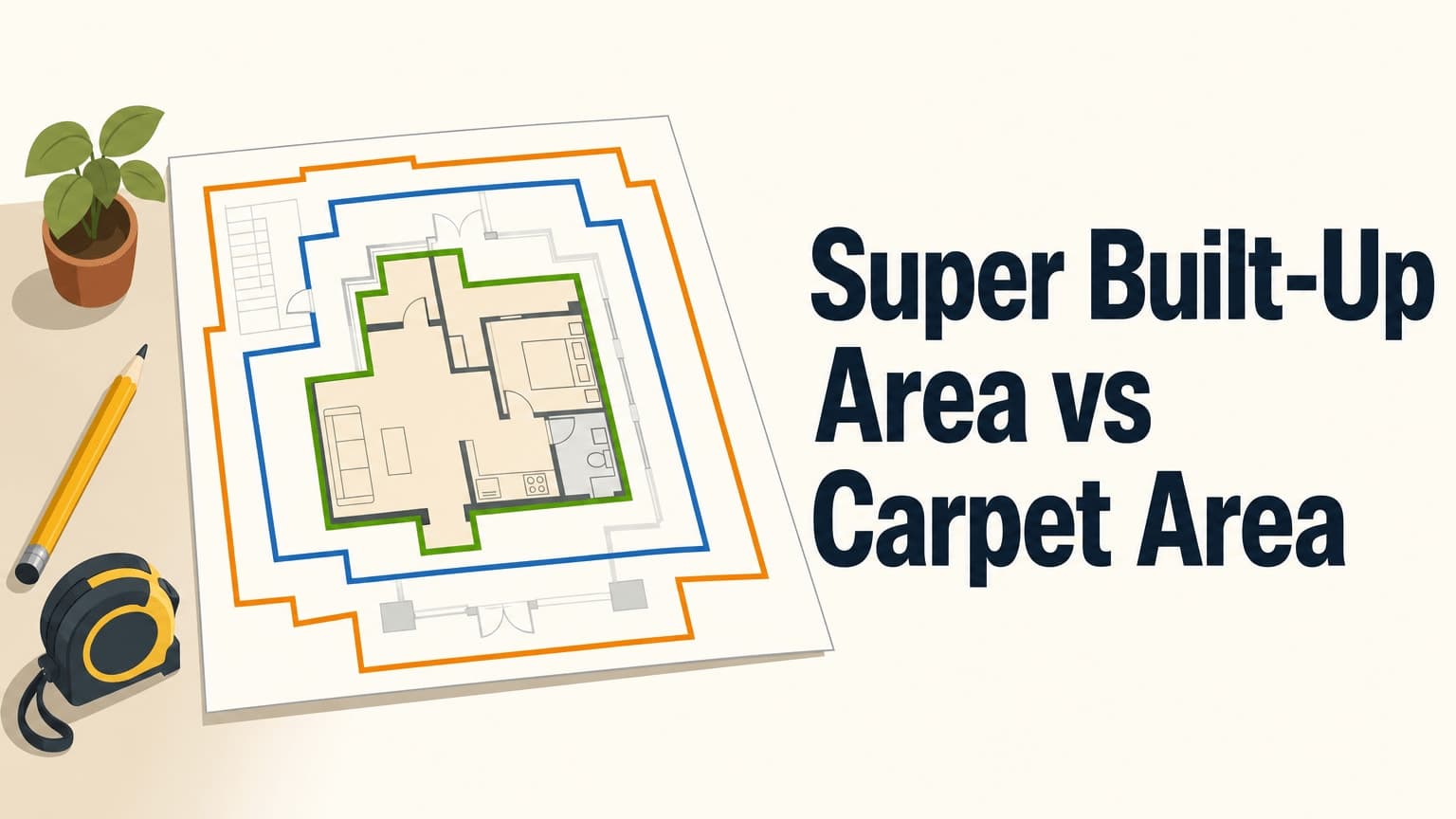
Super built-up area vs carpet area: the short answer
In short: Super built-up area vs carpet area comes down to this: carpet is the floor you can lay a carpet on. Super built-up adds walls, balconies and shared lobbies, and carpet is often around 70% of it.
Most Lucknow brochures still lead with the bigger number, and a price per square foot looks lower when it's spread over more square feet. You aren't being slow if the two figures confuse you. The measure was never standard, and that's the real problem. If you already have a flat in mind and an agreement to sign, our property verification page lists exactly which offices we search before you pay a token.
At a glance, checked 15 October 2026: UP RERA told developers in January 2024 to sell on carpet area only. Your agreement should state it. Divide the price by that figure, not by the brochure's.
What each area actually measures
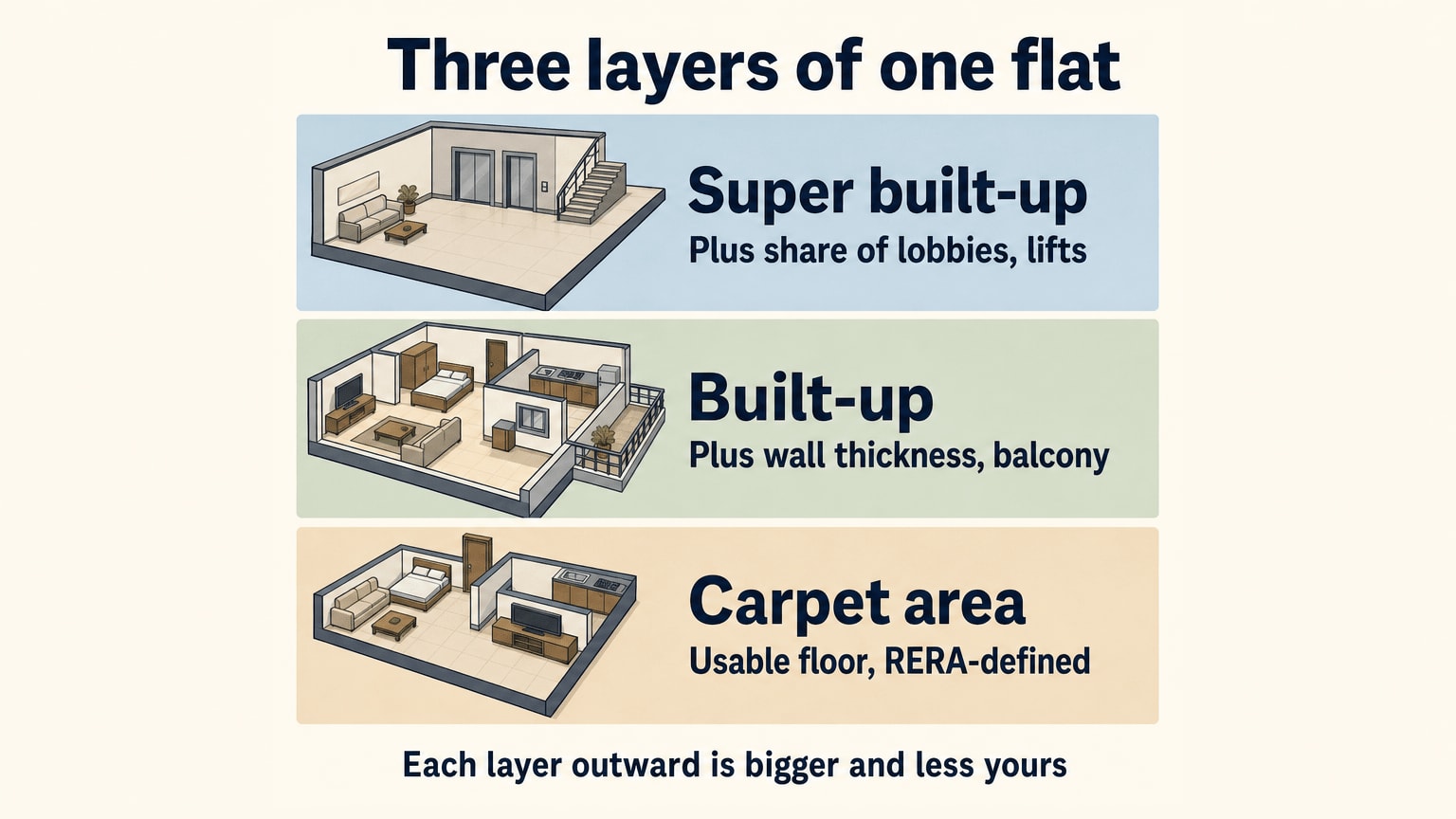
Think of the flat as layers, working outwards from the floor you'd stand on.
Carpet area is the usable floor inside your front door. Bedrooms, living room, kitchen, bathrooms. The Act that governs this is the Real Estate (Regulation and Development) Act, 2016, and its section 2(k) defines carpet area as "the net usable floor area of an apartment, excluding the area covered by external walls, areas under services shafts, exclusive balcony or verandah area and exclusive open terrace area, but includes the area by the internal partition walls of the apartment."
Read that twice, because it has a surprise in it. The internal walls inside your flat are counted. The outer walls, the shafts that carry pipes, and your own balcony are not.
Built-up area is carpet area plus the thickness of the walls, and usually the balcony too. Builders use the word loosely, so ask what a particular brochure means by it. RERA doesn't use it.
Super built-up area is built-up area plus your share of everything the whole building shares: staircases, lobbies, lift shafts, sometimes the clubhouse or the gym. Godrej Capital describes it as including "external walls, balconies and a proportionate share of common areas."
You can't live in the lift shaft. You pay for it anyway if the price is quoted on super built-up area. That's the whole argument in one line.
The three areas side by side
How the three measures differ
| Carpet area | Built-up area | Super built-up area | |
|---|---|---|---|
| What it covers | Usable floor, internal walls included | Carpet plus wall thickness, often balcony | Built-up plus share of common areas |
| Can you use all of it? | Yes | Mostly | No, part is shared |
| Defined in RERA? | Yes, section 2(k) | No | No |
| Size next to the others | Smallest | Middle | Largest |
Source: RERA section 2(k), as reproduced by Taxguru
The pattern to remember is simple. Each step outward is bigger and less yours. Only the first is defined in law.
Why UP RERA wants carpet area
"Super area" has no fixed formula. Haryana's regulator, in the preamble to its carpet-area regulations, called the definitions in builder-buyer agreements vague and widely varying. So two towers in the same sector can load their common areas differently, and you have no way to compare the two quotes.
In January 2024 UP RERA directed developers in the state "to sell units or apartments as per carpet area only." Its reasoning, as reported, was that "there is no abbreviation or definition of Super Area in the RERA Act," and that its model agreement for sale is also based on carpet area. It also said a violation "may cause legal action."
Haryana's regulator went further in writing. Its regulations say that no apartment may be sold on any basis except carpet area. That's Haryana's rule, not Uttar Pradesh's, but it shows where regulators have been heading.
Here's the part we'd be straight about. We read the January 2024 directive through a press report, not on the UP RERA site itself, and we haven't checked whether it has been amended since. We also couldn't confirm from a primary source whether builders may still advertise in super area. In practice you'll keep seeing it in brochures and on listing sites. Treat the agreement, not the brochure, as the document that counts.
What the same flat costs on each measure
Here is the arithmetic, using round numbers that are easy to do in your head. They're illustrative, not a real flat or a real price.
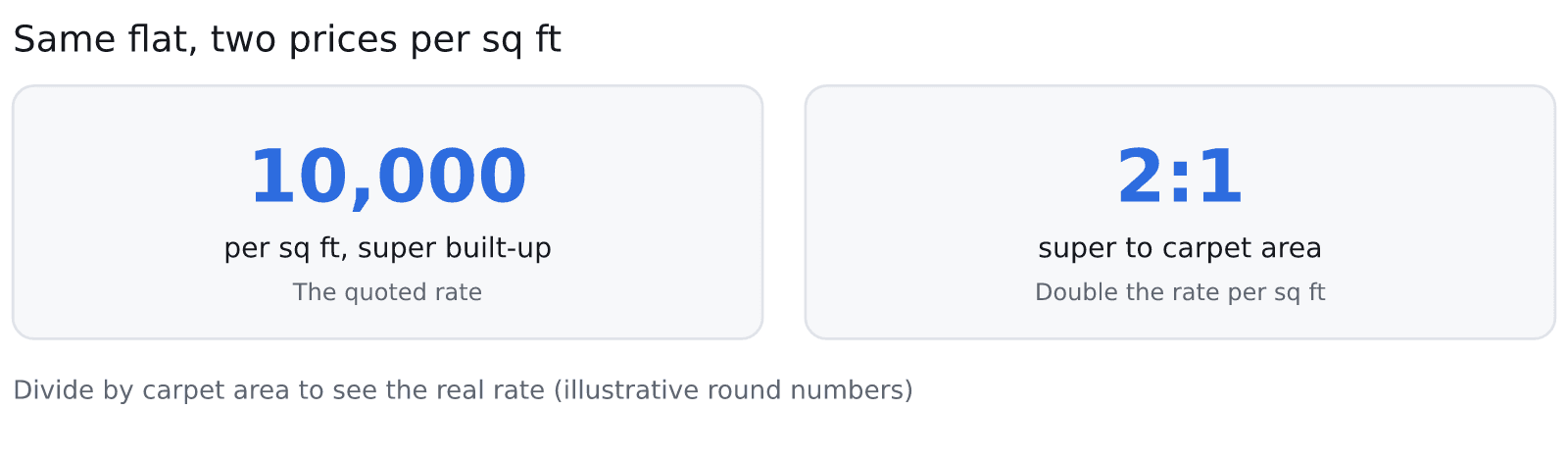
Say a flat is 1,000 sq ft on super built-up area, and its carpet area is 500 sq ft. That's an extreme case, chosen so the sums are quick. The builder quotes 10,000 per sq ft on super built-up area.
Spread over the carpet area, the same money is double the rate per sq ft. The ratio of super to carpet is 2:1, so the price per usable square foot is double the headline.
Real flats usually sit closer together. Godrej Capital says RERA carpet area is "typically around 70% of the super built-up area," and adds that it varies by project. So don't assume a ratio. Get the carpet figure for the exact flat.
Now the useful bit. If a second builder quotes double that rate per sq ft on carpet area for a similar flat, that quote is not dearer. It's the same price, said honestly. You can only see that after you convert.
How to compare two quotes
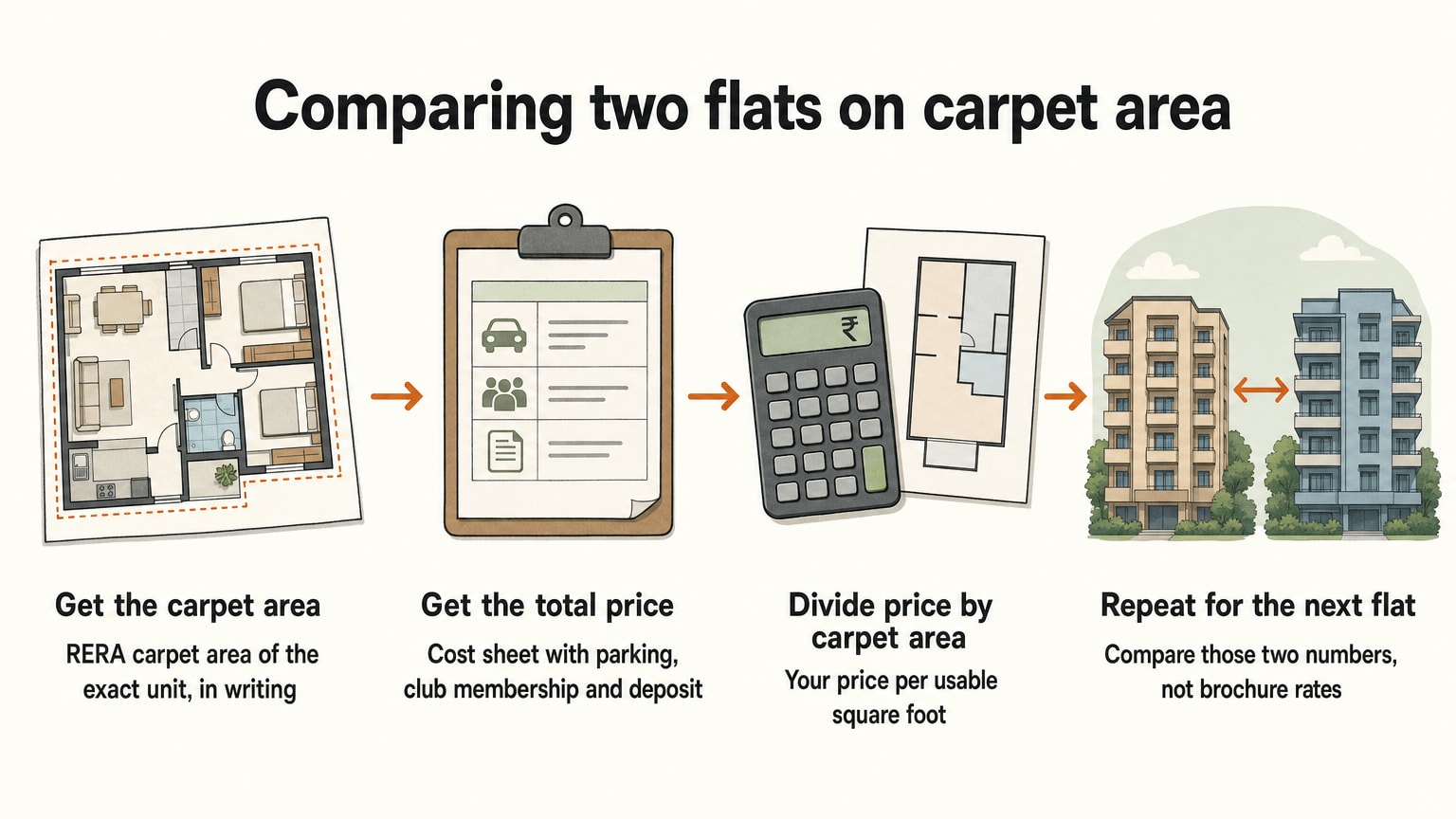
Do this for every flat you shortlist, in the same order.
- Ask for the RERA carpet area of the exact unit, in writing. Not the type, not the "approximate" figure.
- Ask for the total price on the cost sheet, with everything that sits on top: parking, club membership, maintenance deposit.
- Divide the total price by the carpet area. That's your price per usable square foot.
- Do the same for the next flat. Compare those two numbers, not the brochure rates.

Two things trip people up. The first is the balcony. Under the definition above, an exclusive balcony is outside carpet area, so a flat with a big balcony shows a smaller carpet figure than a rival that folds the balcony into "built-up". Look at the balcony yourself. It has value, just a different kind.
The second is wall thickness. Because RERA carpet area counts internal walls, it comes out a little higher than the older "carpet area" that brokers used. Godrej Capital says this typically adds around 5%, so an 800 sq ft general carpet area becomes about 840 sq ft under RERA. If one brochure uses the old method and another uses RERA's, the gap isn't real. Ask which one each means.
Reading a brochure line by line
Take a typical page. It shows a floor plan, a unit number and a single area, usually in square feet, with the words "super area" or "saleable area" beside it. Nothing says what's inside it.
Start by finding the word. If it's carpet area, good, check it against the agreement. If it's super area, saleable area or covered area, treat it as marketing until the builder gives you the carpet figure for that unit in writing.
Then look at the plan itself. Count the rooms you'd use every day and picture the furniture. A 1,000 sq ft flat that's mostly passage, a deep balcony and thick shafts will feel smaller than the number suggests. A tidy plan with the same super figure and a higher carpet figure is the better flat, even though the brochure treats them as equals.
You don't need to do this alone. A site visit with the floor plan in hand, and a tape measure for the main rooms, tells you more in twenty minutes than a week of reading listings. Measure one bedroom. If it's far from the plan, ask why.
What to ask the builder before you sign
Our rule of thumb: if a number isn't in the agreement, it isn't yours. Ask these, and write down who answered.
- What is the carpet area of this exact unit, as registered with UP RERA?
- Does the agreement state price against carpet area, or does it say super area or covered area anywhere?
- Does the area in the agreement match the area in the registered plan?
- What happens to the price if the final area changes after the building is finished? (We couldn't find a confirmed UP rule on this, so get the answer in the agreement itself. Maharashtra's model agreement has a variation clause; don't assume Uttar Pradesh's reads the same.)
- Which common areas are included in the super built-up figure, and are any of them still unbuilt?
The last question matters more than it seems. If the clubhouse is loaded into your area but only exists on a brochure, you've paid for a space you may never get. Say so plainly to the builder.
A RERA possession date is a promise on paper, and we'd never tell you a project will meet it. The area in the agreement is different. You can lock that down on day one.
Our view: carpet area won't make a flat cheap. It makes two flats comparable, and that's what you were missing.
Frequently asked questions
Should I pay for super built-up area?
You'll see the price quoted that way, so you may end up paying on it in effect. But judge the deal on price per carpet square foot. Since UP RERA's January 2024 direction, the agreement is meant to be on carpet area, so ask why yours isn't.
Is a balcony part of carpet area?
Not an exclusive one. The section 2(k) definition excludes "exclusive balcony or verandah area" and "exclusive open terrace area". Brochures often add it into built-up or super built-up area.
Is carpet area always smaller than built-up area?
Yes, because built-up area is carpet area plus wall thickness and usually the balcony. The gap depends on the plan.
What is a loading factor?
It's the extra share of common areas a builder adds on top of your own floor area to reach the super figure. RERA's definition of carpet area has no loading in it, which is why carpet area is the fairer number to compare.
Does the carpet area include walls?
Internal partition walls, yes. External walls and service shafts, no.
Is the super built-up figure illegal now?
Not as a word in a brochure, as far as we could confirm. UP RERA's direction, as reported, is about the basis of sale. We haven't found a primary source on advertising, so ask a lawyer before relying on either view.
- home buying
- RERA
- Lucknow
- flat area